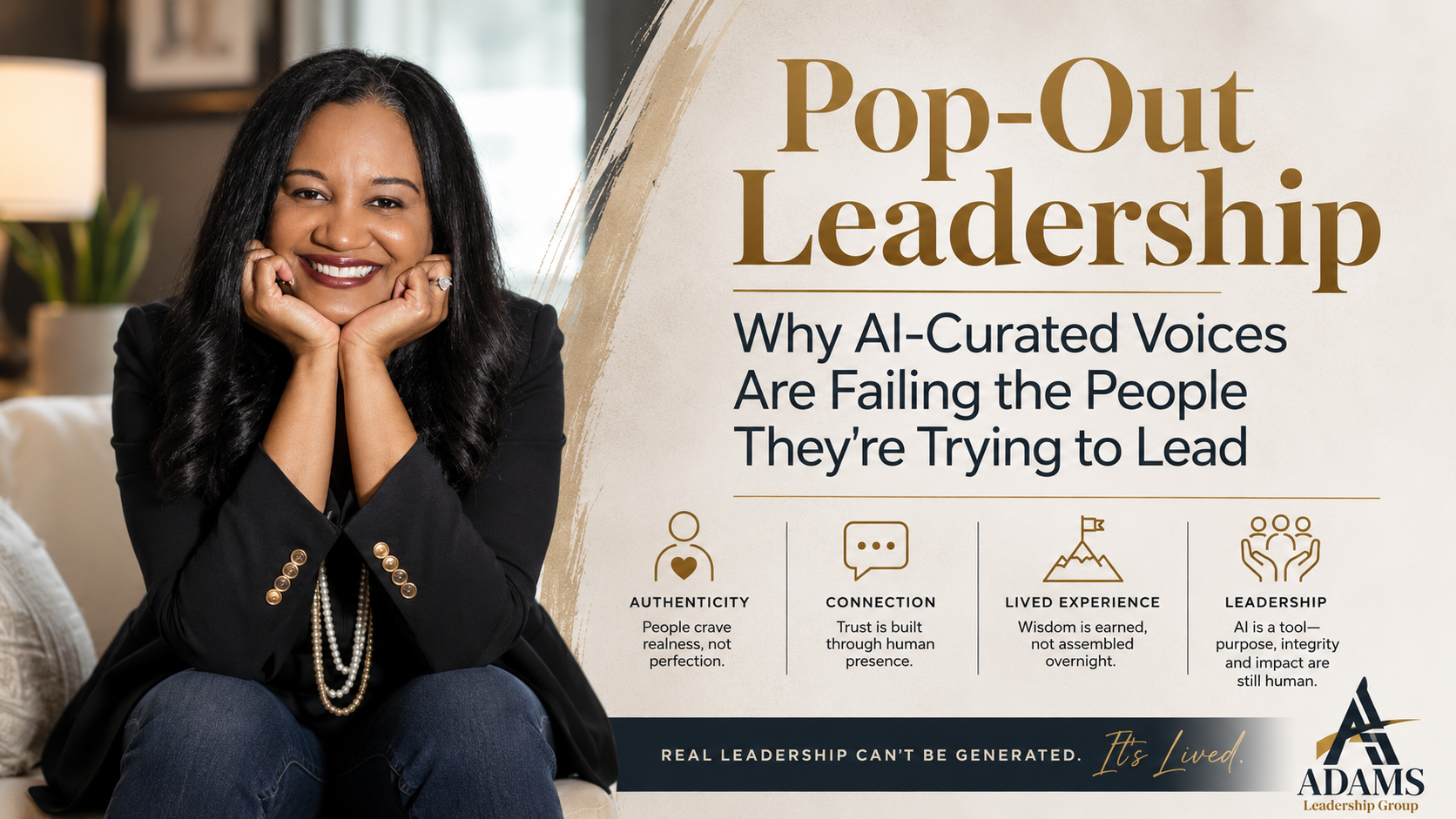
Canena Adams Canena Adams

Leadership That Stands the Test of Time

Leadership is not proven when things are easy. It is revealed in seasons of change. This article explores what it takes to stay grounded in the mission, lead with clarity, and remove self so your leadership can truly stand the test of time.

Leadership is tested most in seasons of change.

Not when things are smooth.
Not when the path is clear.
But when everything around you feels like it’s shifting. Priorities, people, expectations, and outcomes.

That is where genuine leadership shows up.

Over the years, I have learned that leadership that stands the test of time is not built on personality, titles, or even talent alone. It is built on clarity, consistency, and character.

Staying Anchored in the Mission

When change comes, and it always will, the greatest temptation is to react instead of remain rooted.

Strong leaders do not chase every shift.
They do not abandon direction because of pressure.
They do not confuse urgency with importance.

They stay anchored.

They revisit the mission.
They realign the team.
They ask, “Does this move us forward, or is it just noise?”

Because when the mission is clear, decisions become clearer.

And when decisions become clearer, teams become more confident.

Removing Self from the Center

One of the hardest, yet most necessary disciplines in leadership is learning how to remove yourself from the center.

Not your responsibility.
Not your accountability.
But your ego.

Leadership is not about proving a point.
It is not about being the smartest in the room.

It is not about needing credit, control, or constant validation.

It is about stewardship.

It is about asking:
What does the organization need right now?
What does my team need to succeed?
What decision serves the mission, not my preference?

The moment leadership becomes about self, it loses its sustainability.

But when leadership is rooted in purpose, it gains longevity.

Leading Through Change Without Losing Focus

Change will test your focus.

It will try to pull you in multiple directions at once.


It will introduce distractions disguised as opportunities.


It will challenge your patience and stretch your capacity.

But effective leaders develop the discipline to filter.

They do not say yes to everything.
They do not pivot at every opinion.
They do not allow external noise to override internal clarity.

Instead, they lead with intention.

They prioritize what matters most.
They communicate clearly and consistently.
They create alignment, even when circumstances are evolving.

Because the reality is this: focus is not about doing more.

You simply do what matters most, over and over again.

Consistency Over Time

Leadership that lasts is not built in moments. It is built in patterns.

It is how you show up
When no one is watching
When things do not go as planned
When decisions are difficult
When outcomes are uncertain

Consistency builds trust.
Trust builds credibility.
And credibility is what allows your leadership to endure.

Not just for a season, but over time.

A Final Word of Encouragement

If you are in a season of change right now, let me encourage you.

You do not have to have every answer to be an effective leader.

You do have to stay grounded.

Stay grounded in your mission (very important).
Stay grounded in your values (very important).
Stay grounded in who you are called to be as a leader (very important).

Remove what does not belong. Distractions, unnecessary pressure, and the weight of trying to be everything to everyone.

And lead anyway.

Not perfectly.
But purposefully.

At the end of the day… leadership that stands the test of time is not about avoiding change.

You simply learn how to lead through ups and downs with clarity, humility, and a focus on what matters most.

On Purpose, Canena Adams

Read More
Canena Adams Canena Adams

Lead Your Feelings, Don't Follow Them

Some days you feel unstoppable. Other days you want to hide. But leadership and purpose require more than feelings. A reflection on discipline, vision, and learning to lead your emotions instead of being led by them.

Feelings are fleeting. Some days you feel like you could take on the world, and other days you want to crawl somewhere and hide. Most of us know this intellectually, yet we’re still tempted to let those feelings steer the ship. That’s a dangerous habit, and one I’ve had to personally wrestle with.

I feel happy and very good when I’m overconsuming bread, chocolate cake, and steaks — three of my favorites. But the scale has a way of snapping me right back into reality. That’s exactly why I walk hills and remain intentional about disciplining my feelings around food. Left to their own devices, my feelings would have me eating my way through the pantry while calling it self-care.

The same principle extends to every area of life. If feeling good were the ultimate compass, I’d be a wreck of a human being and I’d miss the purpose God has for my life entirely. So the question isn’t whether we have feelings...we do, and they matter. The question is who’s in charge.

Feelings Have a Place. Just Not the Driver’s Seat.

Here’s what I’ve come to believe: feelings are some of the best data we have. They tell us something is wrong before our logic catches up. They fuel passion and creativity. They connect us to the people around us. Dismissing them entirely would be foolish and, frankly, impossible.

But feelings are also wildly unreliable as a decision-making framework. They shift with sleep, hunger, a hard conversation, or a cloudy afternoon. What feels like a catastrophe on Monday morning often looks like a minor setback by Thursday. What feels like a great idea at 11 PM can look very different at 7 AM.

The goal, then, isn’t to suppress feelings but to lead them. Acknowledge them, process them, and then make your decision based on your values, your vision, and your purpose; not the emotion of the moment.

The Leadership Principle in Action

One of the loneliest feelings a leader can experience is carrying a vision that no one else seems to see yet. The idea is clear as day to them. The path makes sense. The potential feels undeniable. But the room is quiet, the team is hesitant, and the support just isn’t there. In those moments, feelings of self-doubt and isolation can be absolutely deafening.

This is where feelings, if left unchecked, become the most dangerous. Because doubt doesn’t always announce itself as doubt. Sometimes it shows up dressed as wisdom. It whispers: Maybe you’re wrong. Maybe you’re ahead of yourself. Maybe you should just be more realistic. And if a leader isn’t grounded in something deeper than how they feel in that moment, they will listen.

A leader ruled by those feelings shrinks the vision to fit what others can currently see. They water it down, play it safe, and trade what could be for what’s comfortable right now. Over time, the vision disappears entirely; not because it was wrong, but because feelings were allowed to make permanent decisions out of temporary circumstances.'

But a leader who disciplines their feelings holds the vision with both hands. They stay curious, keep communicating, and trust the process of bringing others along. They understand that being the first to see something doesn’t mean being the last to carry it. They know that clarity of vision is often ahead of collective buy-in, and that’s not a flaw in the vision...it’s just the nature of leading.

The right people eventually catch up to a leader who refuses to quit. But they never get the chance to catch up to a leader who let their feelings make the call too soon.

Living Fully Without Being Ruled

None of this means life should be joyless or rigidly disciplined to the point of being robotic. Quite the opposite. I believe in living life fully. Enjoying it. Walking in purpose. Savoring the good things, including the occasional steak.

But there’s a meaningful difference between enjoying your feelings and being governed by them. The leader who abandons the vision every time the room doesn’t respond the way they hoped isn’t actually leading...they’re just reacting. And reaction without intention isn’t leadership. It’s just noise.

Real freedom (in life and in leadership), comes from knowing your purpose well enough that your feelings have to answer to it, not the other way around.

Feelings are data, not directions. Acknowledge them. Process them. But lead them and don’t let them lead you. That’s true on the scale, true in the boardroom, and true in life.

On Purpose, Canena Adams

Read More